
Choosing a bathroom fan, step by step
The first and most important step in choosing a fan for your bathroom or toilet is to find out where the ventilation duct from the ventilated bathroom or toilet leads and how long it is. There are several possibilities: it may lead through the wall to the facade, through the roof, or into a central shaft/riser.
Based on the parameters determined, we will choose either a small axial bathroom fan or a small centrifugal bathroom fan. The small axial fans are more common and belong to the category of small and quiet fans (approx. 20 dB). However, they do not achieve sufficient airflow to overcome the resistance of the ventilation duct, which we do not recommend in the case of central shafts without fans on the roof, for example.
Maximum duct length:
A small axial bathroom fan can push air through approximately 3 meters of straight HVAC ducting without bends or branches.
A small centrifugal bathroom fan can push air through more than 5 m of ventilation ducting or a central shaft/riser.
The second step is to measure the ventilated bathroom or toilet in m³ (length x width x height) and multiply the result by the coefficient for the given space.
Bathroom - coefficient 4 times per hour
Toilet - coefficient 3 times per hour
Here is an example of calculating the appropriate fan for a bathroom or toilet:
The bathroom or toilet has dimensions of 2 m (length) x 2.5 m (width) x 2.6 m (height) x 4 (bathroom coefficient) = 52 m³.
Our calculation shows that we will need a small axial fan for a bathroom of up to approx. 100 m³.
We offer small axial fans for bathrooms in 3 diameters.
Connection of fans to ducts and their approximate flow rate:
Ø100 - approx. 100 m³/h
Ø125 (120) - approx. 150-180 m³/h
Ø150 - approx. 250-290 m³/h
We offer small centrifugal fans for bathrooms in two diameters:
Ø80 - centrifugal fans approx. 80-100 m³/h
Ø100 - centrifugal fans approx. 100-280 m³/h
We also offer white plastic round ducting and square plastic ducting. If you need to transition from plastic round ducting to square plastic ducting, it is important to adhere to the same diameter dimensions specified by the manufacturer.
Compatible diameters from round plastic ducting to square plastic ducting
Ø100 mm corresponds to 110x54 mm
Ø125 mm corresponds to 204x60 mm
Ø150 mm corresponds to 220x90 mm
Another criterion is the location of the fan in the bathroom
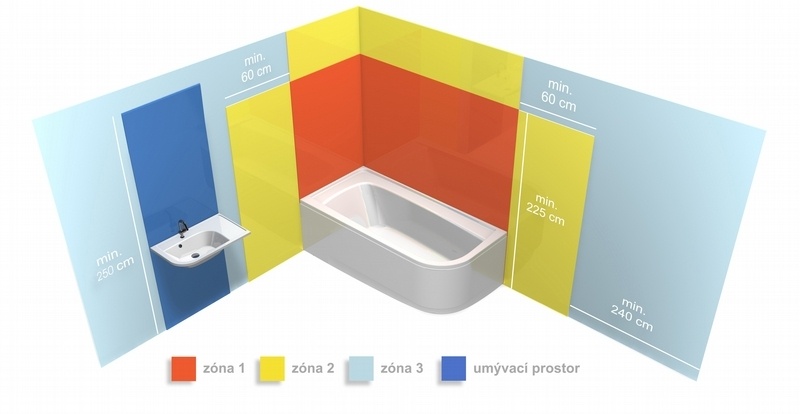
-
Zone 1 – Above a height of 225 cm. Only fans with high IPX4 / IPX5 protection and a voltage of 12V are permitted in these areas.
-
Zone 2 – The area around the bathtub, shower, or sink up to a distance of 60 cm and a height of 225 cm. This zone also includes the area above 225 cm above the edge of the bathtub. The lowest prescribed protection rating is IP44
-
The last zone consists of the area outside the previous three zones, where bathroom fans with the lowest protection rating of IP21 can be installed
Condensation in ventilation ducts
If the duct is short and goes through the wall to the outside, a slight downward slope of the duct from the fan is a sufficient solution. Use a gravity grille with a drip cap or a designer stainless steel facade grille on the facade. If the duct leads in the opposite direction upwards through the attic, a combination of thermally insulated ducting and a condensate outlet is a suitable solution.
Bathroom fan variants
STANDARD MODEL - a fan that turns on when the switch is turned on and turns off when the switch is turned off (can be connected to a light)
DELAYED START - when the wall switch is turned on, the fan starts after a certain time; in some versions, the delay time can be set
OVERRUN TIMER - after turning off the switch, the fan continues to run for a set time, most often 3 to 20 minutes
HUMIDISTAT - the fan reacts to humidity in the room; the humidity value for starting the fan can be set and is usually combined with an adjustable overrun timer
MOTION SENSOR - the fan reacts to movement; no switch is required.
BALL BEARINGS - the fan can be installed on the wall or ceiling