
Fire dampers, heat and smoke exhaust dampers
Fire dampers are classified as closures in HVAC system ductwork that prevent the spread of fire and combustion products from one fire compartment to another by closing the air ducts at their installation points. The dampers as fire closures have different fire resistance depending on how they are installed.
Fire safety of a building is the ability of a structure to minimize the risk of fire and its spread. The fire safety system of a building must be designed in such a way that fire and combustion products cannot spread. From a fire safety perspective, we divide building security into active and passive.
Active building security
The group of active security measures includes the use of so-called fire safety devices. This group of devices includes electric fire alarm systems, stable and semi-stable fire extinguishing devices, automatic explosion protection devices, smoke and heat extraction devices, and fire dampers. Active protection elements primarily protect human lives from the spread of fire and smoke. These active devices facilitate the safe evacuation of people from the building and the effective execution of firefighting operations. The purpose of their installation is to delay or completely suppress flashover. The impact or function of active security elements is important during the development of a fire.
Passive building security
Passive building security includes structural measures. These measures relate to the division of the building into fire compartments, the design of escape routes, fire coatings and seals, etc. Due to the nature of passive safety measures, their function gradually becomes more important over time.
What are fire dampers?
Fire dampers are safety fire barriers that prevent the spread of fire and combustion products from one fire compartment to another by closing the air duct. It is a passive fire protection system that is usually installed in ventilation ducts, air conditioning systems, or wall and floor passages.
The function of a fire damper is simple. During normal operation, the damper is open, allowing air to pass freely. However, in the event of a fire, the damper automatically closes, preventing the spread of fire and smoke to other parts of the building or ducts. This helps minimize the risk of fire spreading and allows people to evacuate to safety.
Fire dampers can be activated in various ways. Some dampers respond to an increase in temperature (thermal fuse), closing when a certain fire temperature is reached. Other dampers can be controlled manually or by servo drives with a return spring and a thermoelectric activation device that identifies the presence of smoke or increased temperature.
It is important to regularly maintain and inspect fire dampers to keep them functional and reliable. Regular maintenance and inspection ensure that the dampers will respond correctly in the event of a fire and fulfill their protective function.
Fire dampers can be installed in the following types of structures:
- in rigid wall or ceiling structures
- in lightweight plasterboard walls
- outside a fire partition with fire insulation of the ventilation duct between the damper and the partition according to the manufacturer's instructions
- installation in a so-called battery; this method of installation is possible if the fire damper has been designed and tested for this method of installation
The most common types of fire damper controls:
- with a thermal fuse without the option of signaling the damper blade position (e.g., FDR-3G H0)
- with a thermal fuse with the option of signaling the damper blade position (e.g., FDR-3G H2)
- with a servo drive and damper blade position indication, the damper drive is controlled by 24V or 230V (e.g., FDR-3G B230T)
Fire dampers with mechanical control
Fire dampers with mechanical control and a thermal fuse that activates the closing device when the nominal trigger temperature of +72°C is reached. The closing device will not activate automatically at temperatures below +70°C.
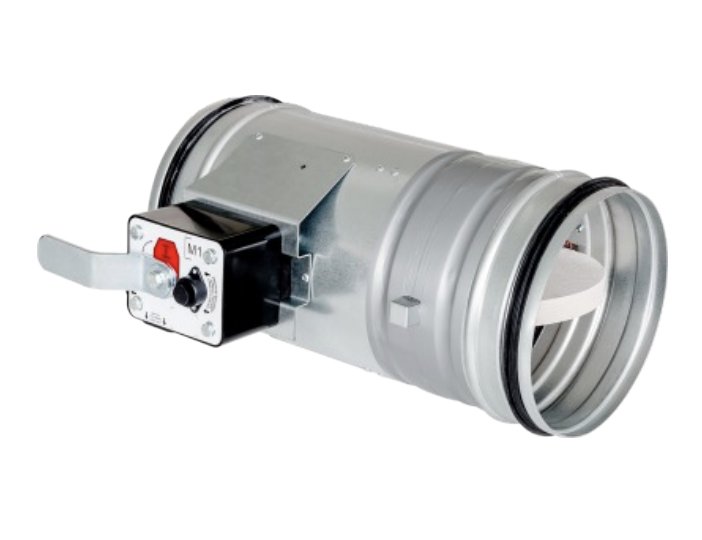
Fire dampers are fire closures for ventilation ducts designed so that the damper blade closes the duct based on a mechanical, thermal, or electrical impulse, preventing the spread of flames, heat, and smoke.

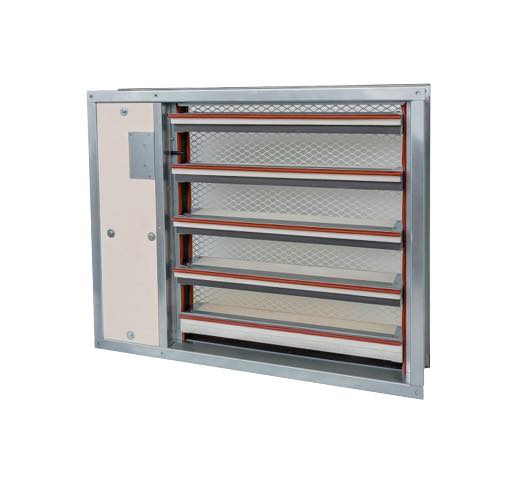
Louvre fire dampers are only available in a motorized version with a servo drive and have two basic uses:
■ Use as a fire damper without connected ventilation ducts with cover grilles for closing ventilation openings in fire-separating walls, structures, elevator and other shafts, cable and other ducts, preventing the spread of heat and combustion products.
■ Use as a lamellar fire damper with connected ventilation ducts on both sides (without grilles) or with ducts on one side (1x grille) to prevent the spread of heat and combustion products through this duct system.
If the damper is affected by fire, it closes automatically or remotely, preventing the spread of fire from one fire compartment to another. The damper blades automatically close the air passage using a servo drive return spring. The servo drive return spring is activated when the thermoelectric trigger device is activated by pressing the reset button or when the servo drive power supply is interrupted. After the blades are closed, the damper is sealed against smoke passage with a silicone seal. At the same time, the damper blade is embedded in a material that expands with increasing temperature and seals the damper airtight. The dampers are not equipped with an inspection opening. When used as a fire damper, the dampers must be equipped with a connecting inspection piece installed directly behind the damper for easy maintenance and inspection.
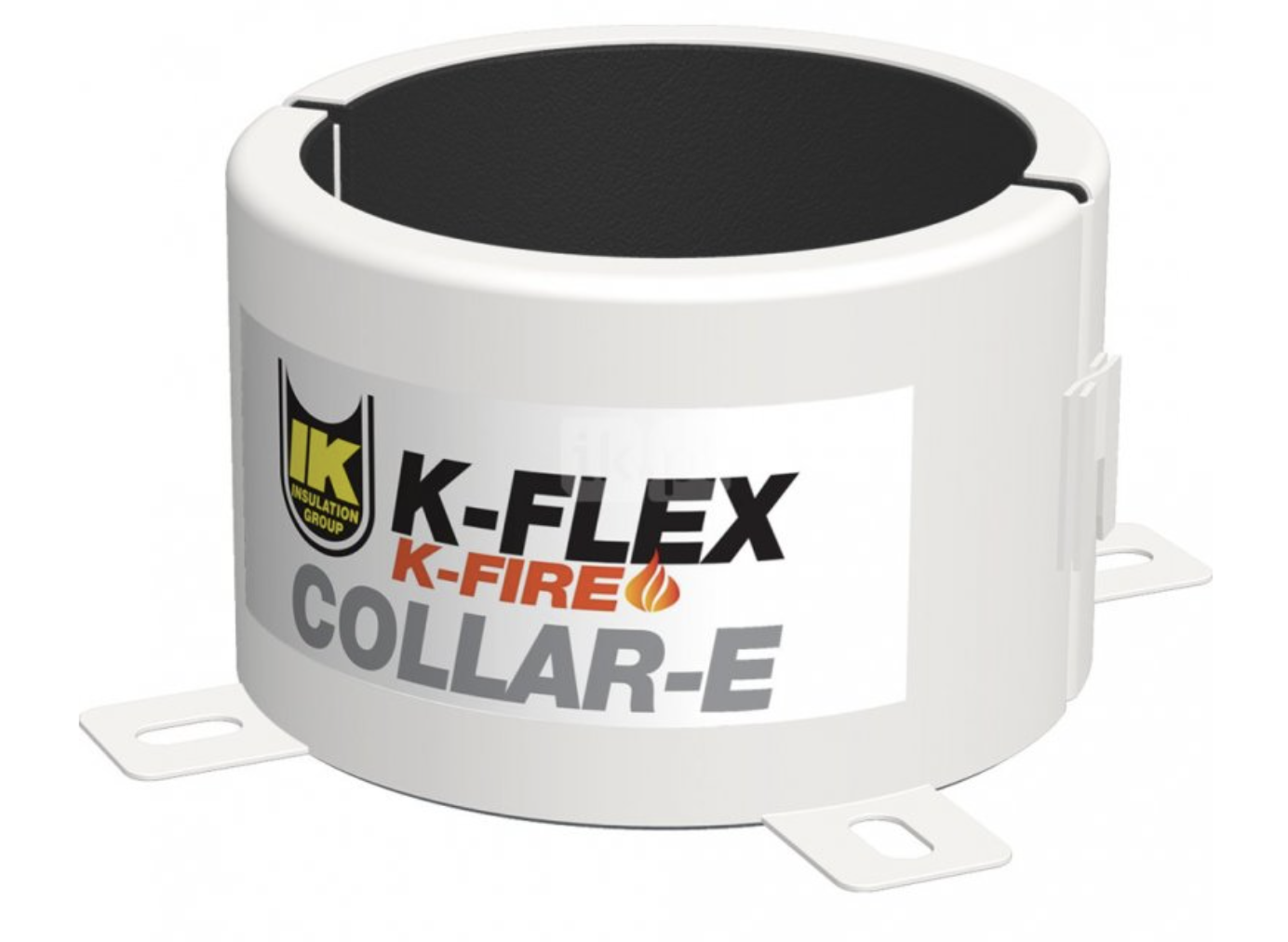
K-Flex K-Fire Collars are designed to be installed around plastic ducts where they pass through fire barriers. During a fire, the intumescent material inside the collar expands, compressing the softened duct and filling the resulting opening, thereby maintaining the fire integrity and insulating properties of the floor or wall.
Best-selling fire dampers in our e-shop:
Mandík FDMR - circular fire damper
Mandík FDMA / FDMB - square fire damper
Brofer BTT - circular fire damper
Brofer MDF - square fire damper
Systemair FDR-3G - circular fire damper
Systemair FDS-3G - square fire damper