
Indoor microclimate and local decentralized units Soler & Palau Respiro N
Proper ventilation essentially ensures air exchange in the interior spaces of buildings. Given that people spend most of their time indoors, the quality of the indoor environment has a significant impact on their health. The indoor microclimate has a significant impact on the occurrence of allergies, respiratory diseases, and other health problems. It is generally known that if buildings do not have excessive humidity and a sufficient supply of fresh air is ensured, the risk of these diseases is generally low.
Currently (given the requirement for energy savings and carbon dioxide reduction), the airtightness of new and insulated buildings has reached such levels that natural ventilation is ineffective. Insulating and sealing the outer shell creates a major problem. This is the problem of insufficient ventilation, which manifests itself in increased internal humidity, accompanied by the growth of mold and concentrations of CO2 and a whole range of harmful toxic substances. This rapidly deteriorates the quality of the indoor air. Mold proliferates, structural damage may occur, and an environment unsuitable for the human organism is created. Recent research around the world has shown a direct link between human health problems and inadequate ventilation.
Opening windows cannot be considered controlled ventilation, as this type of ventilation is dependent on outdoor climatic conditions. Windows are usually opened when there is an unpleasant smell, i.e., only when there is a strong subjective feeling of stale air. Unfortunately, people can adapt very quickly to these sensations (smell or heat) and become indifferent to them, or these stimuli are masked by air fresheners, for example. The biggest problem in this case is not the subjective feeling, but the health consequences caused by harmful substances (CO2, VOCs - volatile organic compounds, formaldehyde, etc.) that are not perceived by the sense of smell. Insufficiently ventilated spaces are very often contaminated with mold, especially in places with higher relative humidity. The most common molds cause allergies and also contribute to the development of cancer.
The presence of harmful substances in the interior is usually only noticed after health problems arise (fatigue, burning eyes, lack of concentration, poor sleep). Allergy-causing substances (pollen, VOCs, etc.) manifest themselves within a short period of time and are therefore easily recognizable, unlike most harmful substances, where health problems only manifest themselves after a very long period of exposure, even 10 to 15 years. This is due to the long-term effects of toxic and carcinogenic substances.
The sources of these harmful substances are found indoors and are produced in smaller concentrations by building structures, common household items, and household products. Among the most dangerous substances that directly threaten health and life is toxic carbon monoxide (CO), which is produced by incomplete combustion (heating, hot water heating, cooking on a gas stove). The main carcinogens include cigarette smoke, formaldehyde (home furnishings, furniture, building structures, paints, detergents, sealants, adhesives).
These concentrations of harmful substances can only be effectively reduced below their permissible exposure limits by adequate ventilation. If we want to reduce the energy consumption of ventilation, we must use controlled ventilation with heat recovery from exhaust air. There are currently a number of forced ventilation systems available. Their selection is influenced by local legislation, standard requirements, and local climatic conditions. Forced ventilation systems are designed to ensure the minimum necessary oxygen supply (minimum air exchange intensity in the space – so-called continuous ventilation) and for more intensive extraction in the event of dangerous concentrations of pollutants (intermittent, time-limited ventilation).
How to ensure indoor air quality without excessive energy consumption?
By means of controlled forced ventilation, in which fans are used as the driving force for air movement. Controlled ventilation with heat recovery is a controlled ventilation system with an exchanger for heat recovery. The exchanger is installed together with the fans in a compact ventilation unit. This unit not only ensures a constant supply of fresh air and the removal of contaminated air, but also saves on heating costs. The air is preheated by the heat recovery exchanger at the cost of operating the unit only, not at the cost of thermal energy or its production. The heat recovery units thus ensure a pleasant environment free of dust, noise, and pollen allergens with ideal indoor humidity.
Decentralized local ventilation units S&P Respiro N
For spaces where it is not possible to install central heat recovery units with air ducts, small decentralized heat recovery units have been developed to ensure effective air exchange without the need for traditional ventilation through open windows. These small heat recovery units were originally designed for ventilating a single room and are often incorrectly referred to as "room or single-room heat recovery" for decentralized ventilation.
The Soler & Palau Respiro N decentralized ventilation units are small and inexpensive devices (compared to central heat recovery units) for ventilation with heat recovery that are very easy to install in the perimeter wall of the ventilated room. They control ventilation by combining air supply and exhaust every 70 seconds, transferring heat to the air stream using a heat exchanger, and effective filtration using G3 filters before and after the exchanger. Depending on the type of heat recovery exchanger used, local units can be divided into recuperative (heat transfer only) and regenerative (heat and moisture transfer).
The central recuperation units are equipped with a classic plate or tube exchanger, two fans (for air supply and exhaust) and filters. These units operate as equal pressure units with simultaneous air supply and exhaust from the ventilated room. Therefore, they do not operate with switching ventilation cycles like units with a regenerative exchanger.
Regenerative units (so-called switching units) are equipped with a ceramic regenerative exchanger, a reversible fan (which ensures the alternation of air exhaust and supply depending on the temperature, flow, and direction of air circulation), and air filtration. The principle of regeneration in these units is that when heated indoor air is extracted, the heat and moisture accumulate in the exchanger, and when outdoor air is drawn in, this heat is released and heats the fresh outdoor air. This significantly saves energy in the heating system.
In the summer, both types of local units use the principle of heat recovery in reverse. They cool the fresh, warmer outdoor air to the original room temperature.
Local decentralized ventilation units were originally designed for ventilating a single room, but today, thanks to the use of EC motors with continuously variable speeds and the development of automatic microprocessor control systems, they are increasingly used for controlled ventilation of entire apartments, family homes, and offices. These systems use multiple units and automatic control systems with ventilation cycles (alternating or synchronous). While one unit supplies air, the other extracts it. These decentralized systems are mainly used because they are easy to install, do not require ductwork, and are easy to maintain.
Recently, there has been a rapid development of decentralized units, mainly in Germany and Austria. In 2018, the EU published the EwWatt study, which dealt with the energy evaluation of decentralized systems with alternating operation. The study concludes that decentralized ventilation achieves high ventilation efficiency that is fully comparable to other systems (e.g., centralized).
What are the advantages of a decentralized ventilation system?
- Provides controlled ventilation with heat recovery
- The supplied air is fresh, without noise, dust, or drafts, reducing the concentration of viruses in the indoor environment and controlling humidity
- Suitable for radon ventilation
- Suitable for new buildings and renovated buildings
- Simple installation of decentralized units in the perimeter wall, without ductwork
- Easy maintenance - only filter replacement and long service life
- Multi-speed wired and wireless control, automatic control of multiple units at once in the sense of "Master" and "Slave"
- Reliability in all weather conditions
- Energy savings on heating (temperature efficiency 40 to 90%)
- Quiet, draught-free ventilation (noise level between 20 and 40 dB)
Variants of S&P Respiro N local decentralized ventilation units:
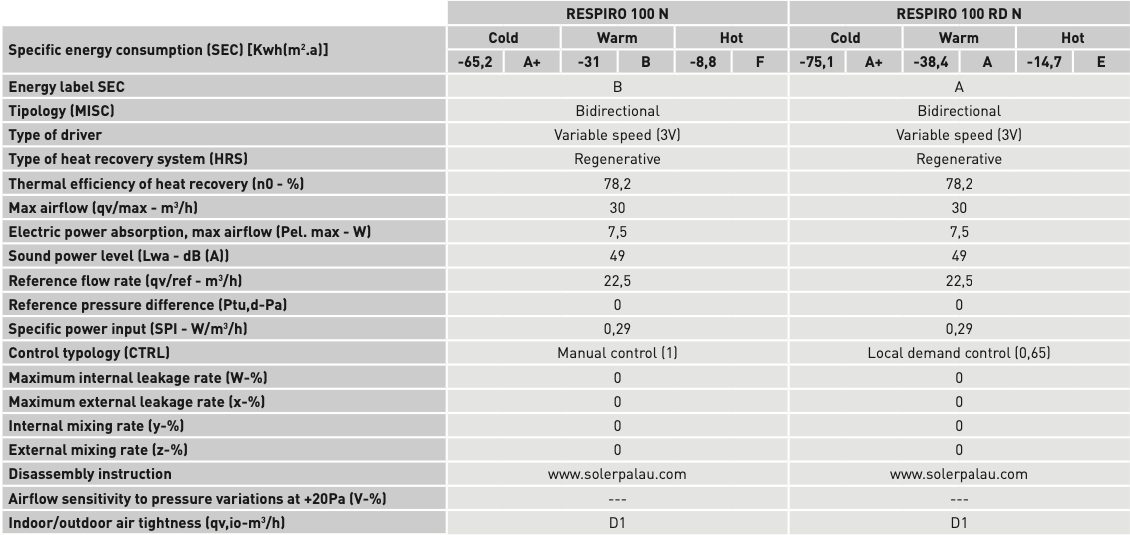
- S&P Respiro 100 N - 3-speed fan, manual control, wireless remote control, diameter 100 mm
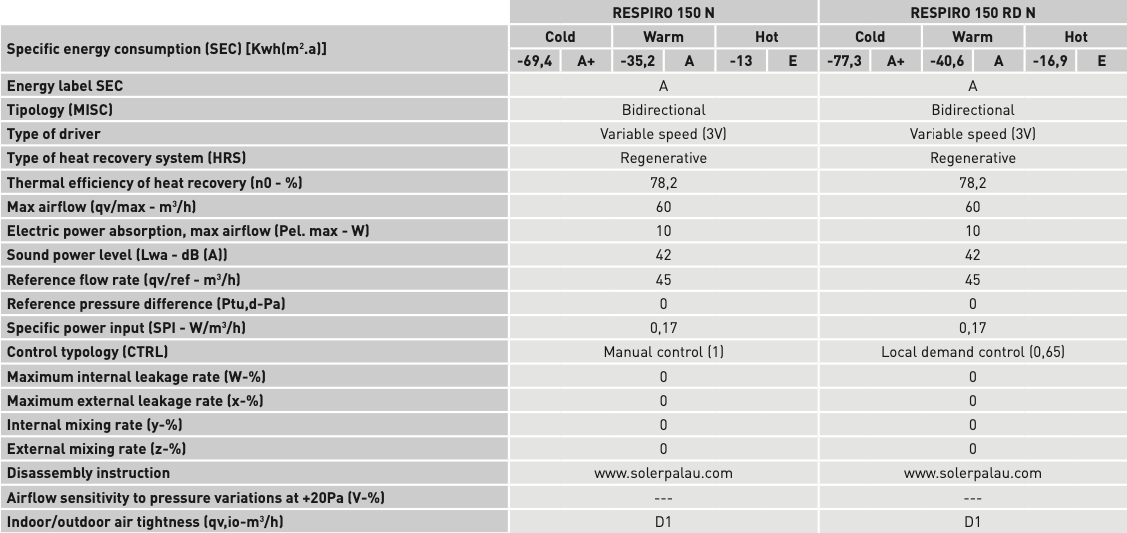
- S&P Respiro 150 N - 3-speed fan, manual control, wireless remote control, diameter 160 mm
- S&P RESPIRO 100 RD N - 3-speed fan, adjustable operating mode, wireless remote control, humidity sensor, possibility to connect up to 16 units
- S&P RESPIRO 150 RD N - 3-speed fan, adjustable operating mode, wireless remote control, humidity sensor, possibility to connect up to 16 units
Design of the S&P Respiro 150 PRO local decentralized ventilation unit:
In automatic mode, the recovery unit switches between exhaust and supply air from/to the room every 70 seconds. The unit is supplied with a remote control. One remote control can control up to 16 RESPIRO 150 PRO units.
The following operating modes can be set using the remote control:
- Automatic mode – fan speed is set automatically by humidity and light intensity sensors (reduced operation at night), ensuring optimal air quality in the room
- Manual mode – manual setting of operating intensity – 3 speeds, sensors disabled
- Standby mode – the unit only switches on when the set humidity level is exceeded
#produkty#/respiro-blog/